Mountain Home Demonstration State Forest
Forest Stats:
Established: 2022
Area: 2,246 acres of which 1,162 acres are timberland, representing 51.7% of the ownership. The non-timber land portions of the property are represented by historically irrigated pasture, annual grass lands, and brush.
Elevation: 1520 - 2440 ft.
Precipitation: 53 inches per year
Temperature: Max: 102 F - Min: 31 F
The Forest has day-use areas. Overnight camping is not permitted.
Directions: The property is relatively difficult to access, and public access is limited. From Redding, take State Route 44 East, turn left onto Old State Route 44, then turn right onto Whitmore Road, and then right onto South Cow Creek Road. This road passes through Section 27 and is the only paved public access to the property.
Research
MHDSF is suited to work with cooperating research partners by writing Timber Harvest Plans that are specifically tailored to meet the needs of current research. Working alongside academic institutions, MHDSF can meet the legislative research component of the MHDSF Forest Management Plan. Current studies are covering topics from Adaptive Silviculture, Assisted Species Migration, and Old-Growth Giant Sequoia Inventory to state-of-the-art inventory methodologies using aerial and terrestrial laser imaging.
Demonstration
Recreation
Miller Demonstration State Forest, is protected both as part of the Demonstration State Forest system and by a conservation easement held and enforced by the Shasta Land Trust, mailing address: PO Box 992026, Redding, CA 96099.
The purpose of the Conservation Easement (CE) is to protect and preserve, in perpetuity, the beneficial public values of the property by restricting uses that could significantly impair those values. The CE enumerates, in detail, the conservation values to be protected on the property.
The conservation values documented in the CE are:
- Fish, Plant and Wildlife Habitat – A diverse range of plant, animal, fungal, and micro biotic communities exist in the ecosystems that make up the property. Habitat for these communities includes a wide range of forest and range structures and various ecological and anthropogenic processes that influence forest dynamics.
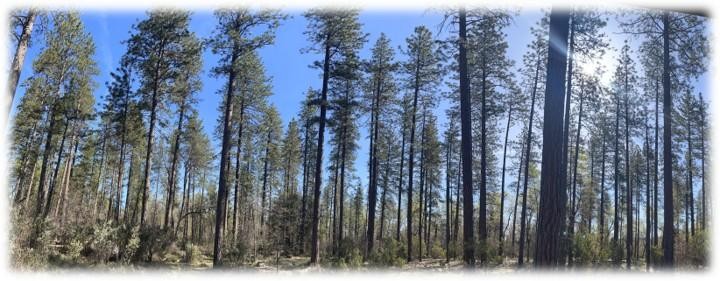
- Forest Resources – The property is heavily forested with a mixed conifer stand that includes ponderosa pine, grey pine, California black oak, incense cedar, and blue oaks. Beneath the canopy are areas of annual grassland and open meadows.
- Open Space – The property provides open space and scenic views that enhance the rural character of Shasta County and its open natural landscape.
- Historic Resources – The property is located within the ancestral territory of the Central Yana people. The character of the property was also historically homesteaded, and the remains of these homesteads can be found across the property.
- Outdoor Recreation – Due to limited access, there is reduced recreation on the property. Existing outdoor recreational opportunities include hiking, berry picking, sightseeing, swimming, and bird watching.
- Agricultural – The property supports agricultural values, including one active grazing license. Grazing has been vital to the region since it was originally settled in the mid-1800s and remains a dominant agricultural use on surrounding lands. The property also supports agriculture through an existing apiary license.
The conservation values established under the CE are fully compatible and complementary to the general goals of the Demonstration State Forest Program. The conservation easement was recorded because the property was included among the PG&E lands designated for donation under the settlement agreement.
Open to pedestrian, equestrian, and bicycle exploration. ATV and OHV use is prohibited under the terms of the Conservation Easement. The Forest has day-use areas. Overnight camping is not permitted.
Hunting is permitted during designated seasons and in accordance with California Department of Fish and Wildlife regulations.
Please be aware of your surroundings and abide by Local, State and Federal laws. There are homes near the forest boundaries.
Cal. Code Regs. tit. 14 § 1413. Weapons.
(a) No person shall discharge any firearm, air or gas weapon, or bow and arrow in the vicinity of camps, residence sites, recreation grounds and areas, and over lakes or other bodies of water adjacent to or within such areas, whereby any person is exposed to injury as a result of such discharge.
(b) Without limiting the foregoing, no person shall discharge any of the above-named weapons or any other weapon while within 150 yards (137.20 m) of any Designated Camping Area.
Cal. Fish and Game Code § 3004.
(a) It is unlawful for a person, other than the owner, person in possession of the premises, or a person having the express permission of the owner or person in possession of the premises, while within 150 yards of an occupied dwelling house, residence, or other building, or within 150 yards of a barn or other outbuilding used in connection with an occupied dwelling house, residence, or other building, to either hunt or discharge a firearm or other deadly weapon while hunting. The 150‑yard area is a “safety zone.”
(b) It is unlawful for a person to intentionally discharge a firearm or release an arrow or crossbow bolt over or across a public road or other established way open to the public in an unsafe and reckless manner.
The Castle Fire burned through Mountain Home Demonstration State Forest during a high wind event on September 13, 2020. Much of the damage was done within the first 24 hours but fire continued to move through the forest until the first snow in late November. Approximately 2,000 acres (40%) were subjected to intense, stand replacing fire including the recent 282-acre donation from the Kemp Family. It is estimated that 20 million board feet of merchantable timber died from the initial impacts of the fire and another 10 million board feet are expected to die from fire and insect damage within a couple of years. This would be enough wood to build over 1,800 single family homes.
Many old growth giant sequoia (OGGS) stumps and logs, particularly at the historic Enterprise sawmill site, were destroyed. Other notable OGGS losses include the Bonsai Tree, a drastic height reduction of the Genesis Tree, and a significant alteration of the Hob Goblin. Over a dozen collapsed OGGS have been observed and it is assumed there are more that have yet to be discovered. It is estimated that hundreds of the 4,750 OGGS on Mountain Home have been severely damaged and are possibly dead.
Recreational resource damage includes the loss of the “House that Jack Built”, five bathrooms, numerous water systems, and other campground infrastructure. Many popular trails and day use areas have hundreds of fire damaged trees that will need to be removed for visitor safety before being re-opened to recreation. Mountain Home will look much different to the recreating public when it is safe to return.
Despite the significant damage, there were also many successes. CAL FIRE has aggressively managed Mountain Home to be a resilient, healthy forest through removing drought and beetle killed trees, controlling forest density, strategically reducing fuel loads, and introducing prescribed fire. These actions limited fire damage to many campgrounds and saved thousands of OGGS within the heart of Mountain Home.
CAL FIRE resource management staff acted quickly to mitigate hazard trees, prepare for reforestation, protect the road system and limit erosion from winter storms. Straw bale dikes have been installed on watercourses above road crossings. Trees have been felled along roadsides to provide safe access and over approximately 800 acres to reduce soil erosion. In 2021, Approximately 600 acres were prepared for planting. In 2022, 200,000 seedlings, including giant sequoia will be planted.
Miller Demonstration State Forest